

Deciding how to pay for dental care can feel overwhelming. On one hand, there’s private dental insurance, a product many Canadians already use via employers or individually. On the other hand, there’s the newer Canadian Dental Care Plan (CDCP), a federal program that aims to fill gaps for people without dental coverage. Which is better? What are the trade-offs?
In this guide, we’ll walk you through dental insurance vs CDCP, how each options work, what they cover, and how to choose what fits you. (Spoiler: there’s no one-size-fits-all answer.)
What is Private Dental Insurance?
When we talk about private dental insurance, we refer to a coverage plan offered by insurance companies (or sometimes bundled with health plans) that helps pay for dental services. Many Canadians get it through their workplace benefits package; others buy it independently.
How Dental Insurance Works
- You pay a monthly or annual premium to an insurance company (or benefits provider).
- In return, when you go to the dentist, you submit claims (or your dentist may bill directly) to receive reimbursement or coverage for part of the cost.
- The insurer sets rules: for example, certain percentages covered, waiting periods before major procedures, annual maximums, exclusions, etc.
- Over time, as you keep paying your premiums without claiming too heavily, coverage may increase.
What Does Dental Insurance Cover?
Private plans generally divide services into tiers:
| Tier | Examples of Services | Typical Coverage Pattern* |
| Preventive / Diagnostic | Exams and cleanings, x-rays, fluoride treatment | High percentage (80-100 %) after short waiting periods |
| Basic Restorative | Fillings, simple extractions, scaling | Lower percentage (60-80 %) |
| Major / Complex | Crowns, root canals, dentures, bridges | Often lower coverage, longer waiting periods, or subject to maximums |
* These numbers are illustrative; actual percentages depend on the specific plan you choose.
Also important: Some plans require you to wait 3, 6, or 12 months before certain types of services become eligible for coverage. For instance, major work may not be covered until you’ve had the plan for a full year.

Pros & Cons of Dental Insurance
Pros
- You often have a broad choice of dentists (especially outside the network).
- More flexibility with which services are covered (depending on plan).
- Predictability, when you budget a premium, big costs become less shocking.
- Can include coverage for things CDCP might not (depending on plan).
Cons
- Premiums and deductibles can be expensive, especially for rich coverage.
- Some services may still be only partially covered (you’ll pay the “balance”).
- Waiting periods can delay needed care.
- Exclusions and caps may leave you paying out of pocket for “major” work.
A helpful tip: when comparing private plans, look closely at what each tier covers, the annual maximum, the waiting periods, and whether the providers you’d use are in-network (if that gives better rates) or out-of-network.
Read more: Everything You Should Know about Dental Insurance for Emergency Care in Canada
Contact Us for Help!
Wondering whether CDCP or a private plan makes more sense right now for your smile? Contact Vancouver Main Dentist; we can run estimates for your treatment and help you see which option saves you more.
What is the Canadian Dental Care Plan (CDCP)?
The Canadian Dental Care Plan is a relatively new federal program intended to make essential dental care more accessible for Canadians who do not already have dental insurance. It’s designed to reduce financial barriers and provide support for basic to major dental needs, within defined rules.
How CDCP Works
- The CDCP is not free coverage for everything; it’s a subsidy or coverage program, not a full insurance replacement.
- To use it, you must apply, be accepted, and you’ll be given a start date after which covered services will be eligible. Services BEFORE that start date generally won’t be reimbursed.
- Dentists participating in the program bill Sun Life (the program manager) directly for those covered services, under fixed-fee schedules set by province/territory and the federal program.
- There is a co-payment structure. Depending on your adjusted family net income, you may still pay a share (like 40 % or 60 %) of the cost.
- Some more complex services require preauthorization before they can be covered.
What CDCP Covers
The CDCP offers coverage across a wide scope of dental care, categorized into:
- Preventive & Diagnostic Services: exams, x-rays, cleanings (scaling), fluoride, sealants.
- Restorative / Basic Services: permanent fillings, temporary fillings, treatments for cavities, pain control.
- Endodontic Services: root canals, pulpectomy, treatment of infections.
- Periodontal Services: cleaning under the gumline, treating abscesses, and managing gum disease.
- Major / Complex Services: crowns (with preauthorization), posts, cores, denture repairs, bridges, partial/complete dentures.
- Oral Surgery: extractions, surgical removal of tumours, cysts, broken jaw repairs, etc.
One limitation: cosmetic dentistry and elective treatments aren’t covered.
Suggested article: CDCP Eligibility: Who Qualifies for the CDCP in 2025?
Key Differences Between Private Insurance and CDCP
Now, let’s directly compare private dental insurance and CDCP. Seeing side-by-side can help you grasp which might make more sense for your situation, or whether combining strategies is possible.
1. Eligibility & Access
Private Insurance is available to many people, either via employer, group benefit, or individually purchasable. There are no strict income cutoffs (though cost may be prohibitive). On the other hand, the CDCP has strict eligibility: you must not have access to any other dental insurance, must file taxes, be under the income threshold, etc.
2. Coverage Scope & Flexibility
Private Insurance has greater flexibility. You can shop among plans, choose coverage options, for example, add orthodontics, implants, and perhaps get higher coverage for certain services. However, it all depends on the plan.
On the other hand, the CDCP is more fixed. It aims to be broad, but services are defined by program rules, fixed fee schedules, and require preauthorization for complex services. You can’t customize much.
3. Cost Structure for You
For private Insurance, you pay a monthly or annual premium. There may also be deductibles, co-payments, annual maximums, and waiting periods. Moreover, you may still pay “balance billing” for treatment beyond what the insurer approves.
However, for the CDCP, you don’t pay a separate premium. Instead, you pay a co-payment depending on income. There’s also no “cap” in the sense of an annual maximum in the same way, but services must conform to program rules and scheduling. Only services after your coverage start date are eligible.
Good to Know: Canadian Dental Care Plan Status Checker Online
4. Provider Choice & Billing
Many private Insurance plans allow you to choose any dentist; some “in-network” ones give better reimbursement rates. You or your dentist submits a claim or coordinates direct billing.
But for the CDCP, dentists must agree to the program rules and fee schedules. They bill Sun Life directly for covered services under CDCP. Some dentists may opt out; you must check whether your dentist participates in CDCP.
5. Overlaps, Coordination, and “Double Dipping”
A common question is: Can you use both a private plan and the CDCP at the same time? The answer is no, that would violate CDCP’s eligibility criteria. However, if you have provincial or other government dental programs, coordination may be allowed (the programs’ “top up” or coordinate payments) in some cases. CDCP is designed to fill the gap for those without coverage, not to be stacked on top of private coverage.
6. Predictability & Risk
Private Insurance offers more predictability of cost (via premiums) in exchange for risk-sharing. However, expensive procedures still might exceed what’s covered. CDCP provides subsidized assistance, but for more complex treatment, your co-payment could still be sizable. Plus, if a necessary procedure is not eligible under CDCP rules or if the dentist does not participate, you’re back to paying full cost.
7. Income Sensitivity
Private Insurance is largely independent of income; if you can afford the premium, you’re in. However, CDCP is very income-sensitive: eligibility depends on adjusted family net income, and co-payment rates rise with income. So you receive more help if your income is lower.
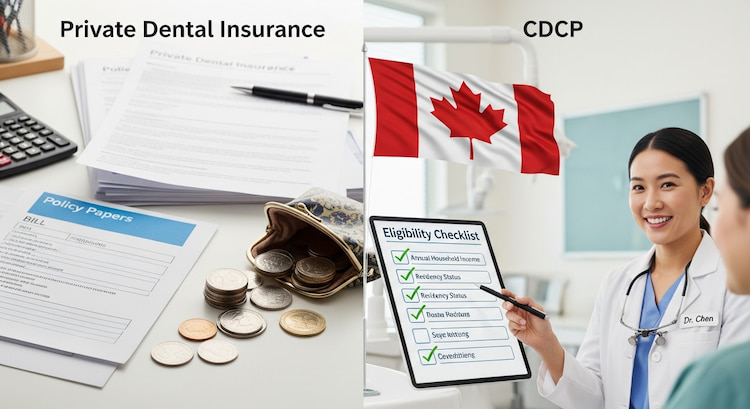
Further Reading: Government Dental Coverage for Seniors in Canada
Which Option is Better for You?
Now we come to what you probably care about most: Which should you choose? (Hint: your personal situation matters a lot.) Below are scenarios, tips, and criteria to help you decide.
What to Ask Yourself
Do you already have dental coverage?
- If yes, you don’t qualify for CDCP while that coverage is active.
- If not, CDCP becomes an option.
What is your income level?
- If your adjusted family net income is well under $90,000, CDCP’s co-payments will likely be less harsh and more helpful.
- If you’re near that limit, you may pay high co-payments under CDCP, making private insurance more competitive.
Learn more about the CDCP co-payments here: Canada.ca
How much dental work do you anticipate needing?
- If mostly routine preventive care and occasional fillings, CDCP (if eligible) can cover a lot of that.
- If you’re planning major work (crowns, implants, extensive orthodontics), a private insurance plan may offer more flexibility or coverage beyond CDCP’s scope.
Worth Reading: A Comprehensive Guide to Free Dental Care for Refugees in Canada
What dentists do you prefer, and do they participate in CDCP?
- Even if you’re eligible for CDCP, if your chosen dentist doesn’t accept it, that reduces utility.
Risk tolerance vs. cost trade-off
- Private insurance gives you “peace of mind” via premiums.
- CDCP lets you allocate funds elsewhere but still gives support, if your eligibility holds.
Examples & Scenarios
1. Emily, age 30, adjusted family income $45,000, no dental coverage. She mostly gets cleanings and occasionally needs fillings. CDCP likely covers most of her needs with low co-payments. She would benefit from enrolling in CDCP instead of paying for a mid-tier private plan.
2. Mark, age 45, income $85,000, no dental coverage, but anticipates needing crowns and a root canal. Under CDCP, his co-payment might be steep (60 %). A private insurance plan that offers 50 to 70 % coverage for major work might end up being more economical for his anticipated procedures.
3. Sarah, age 55, has a workplace private dental benefit. She is not eligible for CDCP while that plan is active. If she loses her job and the benefits, then CDCP becomes an option, provided her income qualifies.

Your Smile Deserves the Right Choice in Dental Insurance vs CDCP
There’s no universal “better” between private dental insurance and CDCP; only what makes more sense for you. Private insurance gives you more choice and flexibility, but you pay a premium and deal with limitations like waiting periods and coverage caps. CDCP is a more targeted, income-sensitive subsidy for individuals without access to dental insurance, helping cover preventive to moderately complex dental services under a defined framework.
At Vancouver Main Dentist, we support CDCP and can help you understand how your treatment plans might be covered under CDCP versus private insurance. Whether you enroll in CDCP or keep (or get) private insurance, the key is to pick the option that reduces surprises and makes your oral care manageable.
FAQ
What’s the difference between private dental insurance and the CDCP?
Private dental insurance is a purchased or employer-provided plan covering a range of services under rules set by insurers (premiums, waiting periods, caps). CDCP is a government-subsidized dental program for those without coverage, with defined eligibility, co-payments, and covered services.
Can I use both dental insurance and CDCP at the same time?
Generally no. One of CDCP’s core eligibility requirements is no access to dental insurance. If you already have private dental coverage, you won’t qualify until that coverage ceases. There may be coordination with other government dental programs in limited cases, but stacking CDCP on top of private insurance is not permitted.
What dental services are covered by CDCP vs private insurance?
CDCP covers preventive, diagnostic, restorative, endodontic, periodontal, major restorative, prosthodontic, and oral surgery (with some requiring preauthorization). Private insurance coverage varies plan to plan, but many include preventive services, basic restorative care, and some major work, sometimes even orthodontics. It also may cover cosmetic treatments if medically necessary.
Who qualifies for the Canadian Dental Care Plan?
To qualify for CDCP, you must have no access to any dental insurance, be a Canadian resident for tax purposes, file taxes (you and any spouse/common-law partner) so income is assessed, and have an adjusted family net income below $90,000.
Do you lean toward CDCP, or do you prefer private insurance? Leave a comment below and let’s get the discussion going.


